Apple iPhone 18 Pro and Pro Max Launch: A20 Pro Chip, Variable Aperture and Bigger Batteries
Apple has taken the wraps off the iPhone 18 Pro and iPhone 18 Pro Max, and the pitch is refreshingly focused: a camera that behaves more like a real lens, a battery that Apple says makes the biggest single-generation jump the iPhone has seen, and a new chip built on a 2-nanometer process. The phones were announced on September 9, opened for pre-order on September 12 and reached stores on September 18 in more than 65 countries, with about 20 further regions following on September 25. Here is what actually changed, what is still labelled beta, and who should pay attention.
A20 Pro: the chip that leans into AI workloads
Both models run on the A20 Pro, the first iPhone chip Apple describes as a 2-nanometer design. The company quotes a six-core CPU with Neural Accelerators built in, a seven-core GPU that it says is up to 40 percent faster than the A19 Pro, and a Neural Engine that has been split into two 16-core blocks for 32 cores in total. Apple says that doubles the AI processing available in the previous generation and that memory bandwidth is up by half.
The emphasis on the neural side is telling. Apple's headline features this year, from a rebuilt Siri to image editing that reasons about a scene, are hungry for on-device compute, and a chip that can keep more of that work local is a practical rather than a cosmetic upgrade. If you want to understand why the industry keeps talking about dedicated AI silicon, our explainer on what actually runs on the device and what goes to the cloud covers the trade-offs in plain language.
Connectivity gets a refresh too. A new in-house wireless chip, the N1, handles Wi-Fi 7, Bluetooth 6 and Thread, while a second-generation Apple modem, the C2, is said to use 15 percent less energy than the one it replaces. In the United States, mmWave 5G remains supported.
Cooling and battery: the quiet headline
Peak benchmark numbers matter less than how long a phone can hold its speed, and Apple's thermal story this year is the more interesting one. The company says the new vapor chamber has three times the surface area of the one in the iPhone 17 Pro and delivers up to 40 percent better sustained performance. The A20 Pro's packaging has also been reworked using ideas borrowed from Apple's M-series chips. Sustained performance is exactly what you feel during a long game session, a 4K video export or extended navigation with the screen at full brightness, and it is worth reading our guide to how vapor chamber cooling works in phones if the term is new to you.
On battery, Apple quotes up to 36 hours of video playback for the iPhone 18 Pro and up to 45 hours for the iPhone 18 Pro Max on eSIM-only models, and calls the Pro Max the largest battery-life increase ever on an iPhone. Models with a physical SIM tray are rated lower; the release says eSIM-only versions gain two extra hours because the freed internal space goes to a larger cell. Apple is offering eSIM-only phones in a list of markets that includes the United States, Canada, Japan and Mexico, so check what your region gets before assuming the top figure applies. If you are unsure what going eSIM-only means day to day, see what changes when you drop the physical SIM.
Charging speeds are stated as up to 50 percent in roughly 15 minutes over a cable and 50 percent in 30 minutes wirelessly. Apple also says five minutes on a wired charger buys about seven hours of video playback on the Pro Max. Those are best-case figures, but they line up with the direction described in our piece on how fast charging really works.
The camera: an aperture you can change
The most talked-about hardware change is the main camera. It remains a 48-megapixel Fusion sensor, but it now has a variable aperture with six laser-cut blades and four settings: f/1.48, f/1.8, f/2.8 and f/4. Physically changing the aperture is unusual in a phone. A wide opening gathers more light and produces a shallower depth of field; a narrower one increases sharpness across the frame and keeps highlights better controlled in bright scenes. Most phones fake a good deal of that computationally.
The Camera app gains pro-style manual control over aperture, shutter speed and white balance, plus a histogram. Photographic Styles have been extended with texture and grain controls, and a new imaging pipeline is said to yield sharper detail. On video, Apple describes cinematic effects that can be applied after the fact at up to 60 frames per second, 4K time-lapse with Dolby Vision HDR, and an improved Audio Mix for voice isolation and music separation.
A different kind of camera feature is Apple Reference Image. It is opt-in and creates an unalterable reference copy of a photo using pixel-signing in the new sensor and Private Cloud Compute, the idea being that you can later prove an image came straight from the camera. Apple also says the phones support the SynthID standard for identifying AI-generated or AI-edited images, with that support arriving later. Whether the average buyer will use either feature is unknown, but for journalists, insurers and anyone who has to argue about what a photo shows, provenance is becoming a real selling point. Sensor size and megapixel counts only tell part of the story, as we explain in our guide to megapixels versus sensor size.
Design details, colors and storage
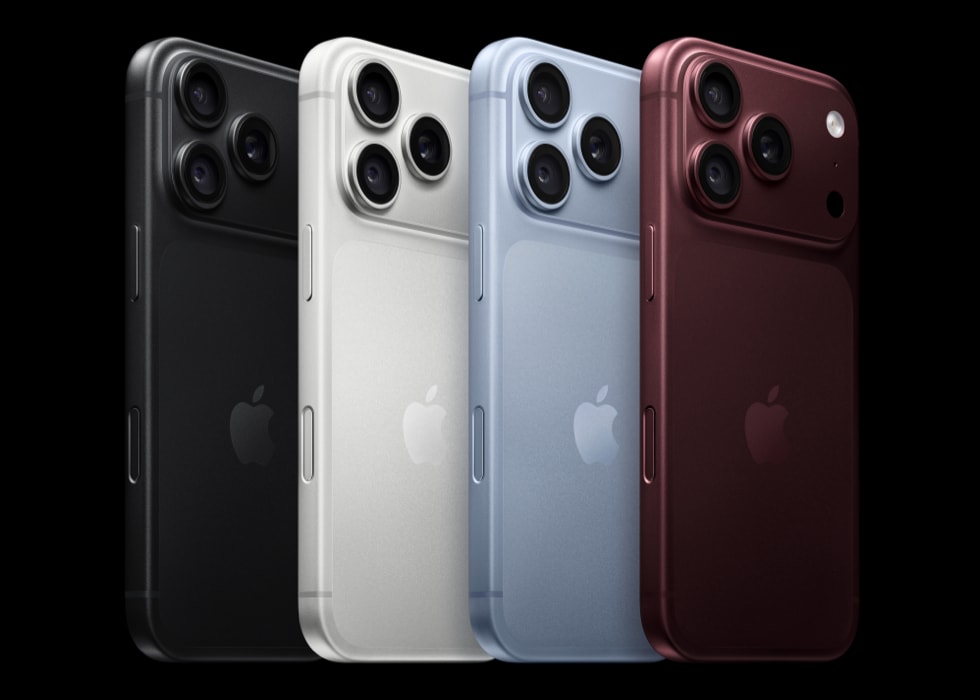
The lineup comes in black, silver, glacier and a new burgundy. Storage options run from 256GB up to 2TB. The Dynamic Island has been redesigned and can now show up to three Live Activities at once while keeping Face ID working. Apple also cites 40 percent recycled content overall, 100 percent recycled cobalt in the battery and 85 percent recycled aluminum in the enclosure.
New accessories include a Wrist Strap at $29 with flexible magnets built in, alongside a Crossbody Strap at $59 and the usual case lineup in the $49 to $59 range.
iOS 27, Siri and the software caveats
The phones ship with iOS 27, which reached existing devices on September 14. The star is a rebuilt Siri that Apple says draws on personal context across messages, email and photos and can act on what is on screen. It is launching in beta, in English first, with French, Japanese, Korean, Portuguese and Spanish due in October. There are daily usage limits on server-side features, it is not available to users under 13 and the European Union will see limitations at first. Additional software additions include photorealistic output in Image Playground, spatial reframing and extend tools in Photos, an upgraded Clean Up, and a Safari option that watches a page and tells you when it changes.
The lesson from earlier Apple Intelligence rollouts is to treat the software as staged. Read the fine print for your language and country before counting on a specific feature at launch. Our explainer on why AI assistants still get things wrong is a useful companion when a feature moves from demo to daily habit.
Pricing and trade-in
In the United States the iPhone 18 Pro starts at $1,199 and the iPhone 18 Pro Max at $1,299, both with 256GB. Apple lists monthly options of $49.95 and $54.12 over 24 months and lease-style Apple Upgrade plans from $34.99 a month. Apple Trade In credits are quoted at $175 to $885 for an iPhone 13 or later, and carrier promotions are said to reach up to $1,200 for an iPhone 14 or later. Because trade-in offers vary widely, our breakdown of how trade-in programs value your phone is worth a read before you hand anything over.
Who should buy, and who should wait
If your current phone is an iPhone 13 or 14 and battery life and camera flexibility matter to you, the 18 Pro family looks like a meaningful step. The variable aperture and the sustained-performance gains should be most obvious to people who shoot a lot or game for extended sessions. If you own last year's model, the case is thinner: the improvements are real but evolutionary, and much of the software story is not tied to the new hardware alone, since iOS 27 is a free update. As a rule of thumb, buy when your battery health or storage is holding you back rather than because the calendar says September, and consult our upgrade-cycle guide to sanity-check the decision. If you do buy, pick the storage tier first, since you cannot add it later, and check whether your country receives the eSIM-only battery ratings.