Mobile Phone Specs and Smartphone Reviews Catalog
Every few weeks a new handset lands, and the same questions follow. Which chipset does it use, how big is the battery, and is the screen 120 Hz? Anyone tracking the mobile phone market knows the answers sit in scattered launch posts.
One resource that deserves a place in your bookmarks is the English edition of mobilkanal.com, which describes itself as an independent smartphone catalog. If you read smartphone reviews to decide what to buy, or simply like to keep up with specifications, it offers a structured way to do that. In this feature we walk through what it contains, how to use it, and where its limits are.
Why a catalog still matters for smartphone reviews
Traditional smartphone reviews are a snapshot. A writer spends a week with one device, files a verdict, and moves on. That format is valuable, but it is poor at answering broader questions such as "which mobile phone in this price band has the largest battery?"
A catalog works the other way round. Instead of one long story about one handset, it holds hundreds of consistent records that you can sort, filter and compare. Because every entry follows the same layout, you can scan quickly and spot differences that a narrative review might bury in the fifth paragraph.
That is the basic idea behind mobilkanal.com. It does not replace a hands-on verdict, and we will be clear about that later. Rather, it gives you a solid factual base before you read anything else.
What the mobile phone database contains
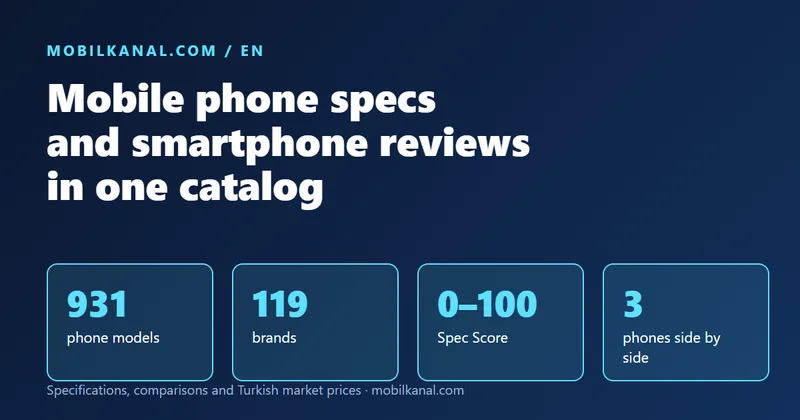
As of October 2026, the English edition lists 931 phone models from 119 brands. The brands with the most entries are Samsung (114 models), Apple (81), Xiaomi (67), Oppo (57) and vivo (57), followed by Honor, OnePlus, Huawei, Realme, Google, Poco and Asus. That spread matters because it covers both household names and smaller makers you may not see in mainstream coverage.
Each mobile phone page carries a full specification sheet. The fields include:
- display details
- chipset
- memory, meaning RAM and storage
- cameras
- battery
- connectivity, such as 5G, Wi-Fi, Bluetooth and NFC
- size and weight
- operating system and release date
Beyond the table, every page includes a short editor's note called the MobilKanal Note. It is written from the listed features and explains in plain language what the numbers mean in daily use. The catalog also leaves unknown values blank rather than guessing, which is a small but welcome sign of care.
A tour of the main sections
The site is organised into clear areas, so you rarely need to hunt for anything. Here is how they fit together.
Phones and Brands
The phone list can be filtered by brand, while the brand pages collect each maker's models in one place. This is the fastest route if you already own a device and want to see what its successor changed.
Reviews, News and Glossary
The English edition holds hundreds of reviews, news items and comparison pages. The smartphone reviews are organised under familiar headings: design, display, performance, camera and battery. The news section covers launches, leaks and industry developments, with each story including the device's specifications and some background.
The glossary explains more than 300 terms, from 2G to Zigbee, including everyday ones such as AMOLED and Wi-Fi. If you have ever nodded along to a spec you did not quite understand, this is the page to keep open in a second tab.
FAQ
A dedicated FAQ explains how prices are kept up to date, how to run a comparison, and how to request a model that is not listed yet. A forum is also planned, but it is marked "coming soon", so do not expect to find a discussion board today.
Understanding the Spec Score behind the smartphone reviews
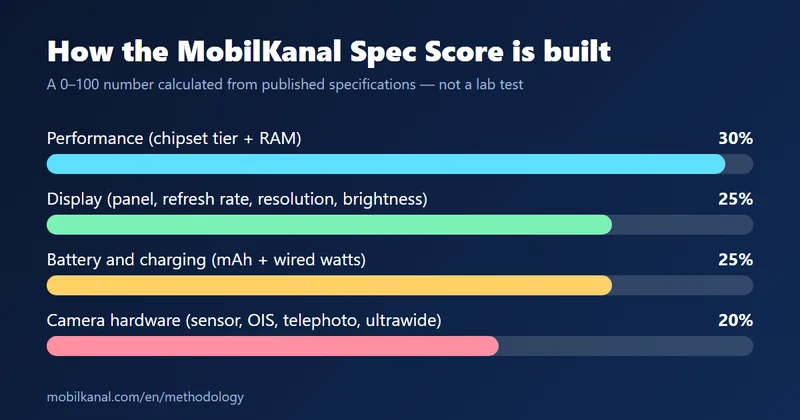
The feature that most distinguishes the site is the MobilKanal Spec Score, a number from 0 to 100 calculated by formula from published specifications. It is worth understanding how it is built, because the weighting tells you what the score rewards.
- Performance (30%) looks at the chipset generation tier plus a RAM adjustment.
- Display (25%) considers OLED or AMOLED panels, refresh rates such as 90, 120 and 144 Hz and above, resolution and peak brightness.
- Battery and charging (25%) weighs capacity in mAh at roughly 65% of this part and wired charging power in watts at roughly 35%, with a small bonus for wireless charging.
- Camera hardware (20%) reviews the main sensor's resolution and size, optical stabilisation, telephoto and ultra-wide lenses, and the top video mode.
Notice the wording on the camera part: it describes hardware only. Photo quality itself is not measured.
What the score does not tell you
The site is open about this, and so should we be. The Spec Score is not a test result and no laboratory measurements are involved. It does not capture real battery life, screen calibration, speaker or call quality, image processing, low-light results, video stabilisation in practice, software update policy, build quality, repairability or how prices move over time.
In short, treat it as a consistent way to sort a long list. It is a starting filter, not a final verdict.
How to build a mobile phone shortlist in five steps
Knowing the sections is one thing; using them well is another. Here is a practical routine that works when you are shopping or just curious.
First, decide on the two or three things that matter most to you, for example battery endurance or a bright display. Second, open the Top lists and find the ranking that matches. Third, note four or five handsets that appear near the top. Fourth, read the individual pages for those models, including the editor's note. Finally, put your candidates into the compare page and look at the differences side by side.
Sticking to this order keeps you from falling for a single flashy number. It also means that by the time you read other smartphone reviews elsewhere, you already know which questions to ask.
Using the Top lists to narrow a mobile phone search
The Top lists live under the "best" section, and each one ranks phones by a single measurable criterion rather than a vague overall opinion. That is a useful design choice, because it tells you exactly why a handset appears where it does.
The lists currently include:
- Highest-Scoring Phones by Specifications
- Phones with the Biggest Batteries
- Fastest-Charging Phones
- Phones with the Best Display Specifications
- Fastest Phones by Chipset and Memory
- Phones with the Strongest Camera Hardware
- Best-Value Phones by Specs per Price
- Best Phones Under $300, $500 and $800
The budget lists are handy for a first pass, since they let you set a ceiling before you compare anything. Just remember that some lists convert Turkish market prices into dollars, so the figures are indicative rather than exact.
How to read a mobile phone spec sheet properly
A specification table can look intimidating, yet a few habits make it manageable. Start with the chipset and memory, because they set the ceiling for speed and for how long the handset stays comfortable to use. Next, check the display type and refresh rate, then the battery capacity together with the charging wattage.
After that, look at connectivity. If you travel, confirm that the 5G support suits your needs; if you pay with your phone, look for NFC. Finally, check the release date and operating system, which hint at how current the hardware is.
Whenever a term is unfamiliar, jump to the glossary. Doing this a few times is the quickest way to build real fluency, and it makes later smartphone reviews from any source easier to judge.
Using the compare page when a new phone launches
This is where the catalog earns its keep. Imagine a new handset is announced and the headlines call it a big upgrade. Rather than trusting the marketing, open the compare page and set it beside last year's model.
The tool puts two or three phones side by side in one table covering display, chipset, camera, battery and price. A few things to do with it:
- Compare the new model with the one you own now, to see whether upgrading is worthwhile.
- Put a flagship next to a cheaper sibling from the same brand and see what the extra money buys.
- Test a rival brand's alternative against your current favourite.
Often the table reveals that a headline feature changed less than the launch event suggested. Occasionally it shows the opposite, a quiet improvement such as faster charging that never made the slide deck.
Prices and the value score
Prices on the site are shown in Turkish lira (TRY) and come from the Turkish market, where a price is available. Because those figures move, the site recommends confirming the latest price with the seller before you buy. We would go further and say that you should treat any listed price as a guide.
The value score is the site's take on price versus performance. For phones with a current Turkish price, the Spec Score is divided by a smoothed function of that price, and the result is converted to a percentile among all priced phones. A value score of 80 therefore means a phone offers more specification for its price than roughly 80% of priced handsets.
It is a neat idea, but it inherits every limit of the Spec Score. Treat it as a pointer toward good-looking deals, then check the details yourself. Readers outside Turkey should also keep in mind that local pricing may not match what they pay.
Who will get the most from this resource
Not every reader needs a catalog, so it helps to be specific about who benefits.
- Buyers building a shortlist who want to filter by measurable criteria before reading long reviews.
- News followers who want to check a launch against the previous generation within minutes.
- Newcomers who need the glossary to decode specification jargon.
- Enthusiasts who enjoy browsing a broad mobile phone database across many brands.
If you need verdicts on camera quality, battery life in real conditions or software polish, you will still want hands-on testing from other sources. The catalog is a complement to that work, not a substitute.
How we looked at it
For this feature we browsed the English edition as a reader would. We checked the phone list and brand pages, opened the compare tool, read through the Top lists and consulted the methodology page that explains the Spec Score. We also looked at the glossary and the FAQ.
What stood out was consistency. Pages are laid out the same way, the scoring weights are published, and the site states plainly what its numbers cannot do. We did not run laboratory tests, and neither does the catalog: its reviews are built on published specifications. We have deliberately left individual scores and prices out of this piece, since those values change and you should read them on the site itself.
For more of what we cover, see our smartphones coverage, and learn about this site if you are new here.
Frequently asked questions
Is the Spec Score a test result?
No. It is a 0 to 100 number calculated from published specifications. No laboratory measurements are involved, and it does not reflect image quality, software polish or real-world battery life.
How many phones can I compare at once?
The compare page handles two or three phones side by side. The table covers display, chipset, camera, battery and price, which makes it easy to see where handsets differ.
Are the prices in US dollars?
Prices are given in Turkish lira from the Turkish market when available. Some lists convert Turkish listings into dollars, so confirm the latest price with the seller before buying.
Does the site have a forum?
Not yet. A forum is marked as "coming soon", so for now the site focuses on specifications, reviews, news, comparisons and the glossary.
What if my phone is not listed?
The site's FAQ explains how to request a model that is missing. Unknown values are left blank instead of estimated, so you will not find invented numbers filling the gaps.
Conclusion
A good reference does not tell you what to think; it helps you ask better questions. With 931 models, 119 brands, transparent scoring and a handy compare page, the English edition of mobilkanal.com gives anyone who follows the mobile phone market a dependable place to start. Use it to shortlist, then read hands-on smartphone reviews before you spend money.
If you have questions about how we cover devices, our reader FAQ is the place to begin.