Google Pixel 9 Pro vs iPhone 16 Pro: Which Computational Photography Actually Wins
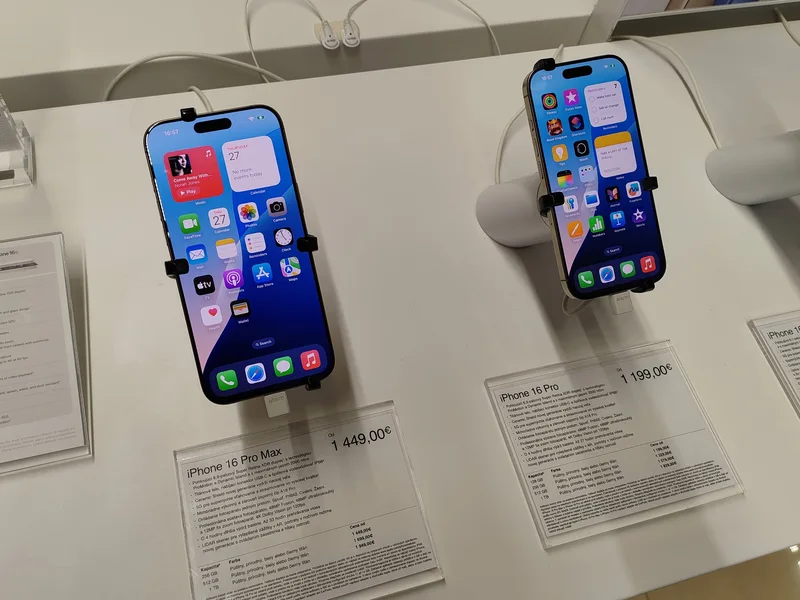
Google and Apple have converged on nearly identical camera hardware specs for their current flagships, which makes the real difference almost entirely about software philosophy. The Pixel 9 Pro and the iPhone 16 Pro both carry three rear lenses in the 48-50 megapixel range, both shoot 5x optical-equivalent telephoto, and both lean hard on their respective AI silicon to do the actual "computational photography" work. What separates them is what each company decided that silicon should be doing while you press the shutter, and what it keeps doing to the file after you've already put the phone back in your pocket.
The hardware, briefly
The Pixel 9 Pro pairs a 50MP primary sensor with a 48MP ultrawide and a 48MP 5x periscope telephoto, all driven by Google's Tensor G4 chip, whose main job is feeding Google's imaging pipeline rather than winning raw benchmark charts. The iPhone 16 Pro pairs a 48MP main sensor with a 48MP ultrawide and a 12MP 5x tetraprism telephoto, run through the A18 Pro's Neural Engine. On paper the iPhone's telephoto resolution looks like the weaker spec, but Apple's tetraprism design and pixel-binning approach have consistently punched above that number in side-by-side daylight test shots over the past two generations, so raw megapixels alone are not a reliable predictor here.
Where the Pixel actually wins
Google's advantage isn't really "better hardware," it's a multi-year head start on generative and semantic editing tools that ship directly in the stock camera and gallery apps. Magic Editor lets you select any object in a shot and move, resize, or delete it, with the background regenerated by a diffusion model rather than a simple clone-stamp. Best Take scans a burst of group photos and lets you swap in the best-expression version of each person's face from a different frame in the same burst. Add Me uses AR alignment to let the person taking the photo be composited into the same group shot they were standing outside of. None of this requires a third-party app, a subscription, or a desktop computer — it happens in the Pixel's own Photos app within seconds. For low light specifically, Night Sight on the Pixel 9 Pro remains the more aggressive of the two systems, pulling in more shadow detail at the cost of occasionally over-brightening a scene that was genuinely supposed to look dark.
Where the iPhone actually wins
Apple's pitch is closer to "we won't touch your photo unless you ask us to." Photographic Styles on the iPhone 16 Pro apply tonal adjustments at the point of capture, per-pixel, based on scene depth — meaning skin tones are protected even while the rest of the image gets a stronger color grade — but they don't invent or move content the way Magic Editor does. The Camera Control button, the new capacitive/pressure strip on the phone's side, genuinely changes how you shoot: a light press brings up a quick-access strip for zoom and exposure without your thumb ever crossing the frame, and a double light-press swaps between camera-app tools. For anyone who shoots RAW, ProRAW and ProRes give the iPhone 16 Pro a real workflow advantage that the Pixel doesn't match: you get an actual 48MP DNG file with full Apple color science baked in as metadata, editable losslessly in Lightroom or Photoshop, not just a JPEG with AI post-processing already committed.
The AI layer underneath both
Both phones now route a meaningful share of their camera decisions through on-device generative AI, and both companies are still figuring out how transparent to be about it. Google is the more upfront of the two — Magic Editor shows a visible "Reimagine" watermark-style disclosure workflow, and Google has published details on which edits use generative fill versus simple pixel manipulation. Apple's Apple Intelligence camera features, by contrast, lean toward invisible assistance: Photographic Styles and the new Clean Up tool (Apple's answer to Magic Eraser) work quietly in the background without much fanfare about the underlying model. If you care about knowing exactly when a photo has been synthetically altered versus optically captured, the Pixel is currently the more legible of the two systems.
Video and everyday shooting
For casual daily shooting — group photos, food, kids, pets — the gap between these two cameras is genuinely small, and most people switching from one ecosystem to the other would not notice a meaningful quality drop. Video is where the iPhone 16 Pro pulls ahead more clearly: 4K ProRes recording direct to an external SSD, Cinematic mode with real-time depth-based rack focus, and Log encoding for colorists are all iPhone-exclusive at this tier. The Pixel 9 Pro's video is solid and well-stabilized but doesn't target the same professional video workflow at all.
Portrait mode and skin tones
Skin tone rendering has historically been the sharpest dividing line between these two camera systems, and it's still visible if you look closely. Apple's Photographic Styles pipeline was specifically retrained to preserve a wider range of skin tones without the over-smoothing that plagued earlier iPhone portrait modes, and in mixed-lighting portraits — a subject partly in shade, partly in direct sun — the iPhone 16 Pro tends to hold detail in both zones more evenly. The Pixel 9 Pro's Real Tone technology, which Google specifically built to correct historical bias in camera skin-tone algorithms, does a genuinely strong job in a single, consistent light source, but can occasionally overcorrect exposure in split-lighting scenes the way it tries to brighten shadowed skin. Neither company has "solved" portrait photography, but both have clearly invested real engineering time in a problem that used to be treated as a footnote.
Telephoto reach in practice
For anything beyond arm's length — kids at a school play, wildlife, concerts, sports from the stands — the 5x telephoto is where you'll spend more time than the spec sheet suggests. The iPhone's tetraprism design keeps the lens physically compact while folding the light path internally, and Apple's computational zoom extends usably out to around 10x-12x with acceptable softness before it falls apart. The Pixel's Super Res Zoom, built on the same 48MP telephoto sensor, pushes digital zoom further on paper (Google advertises up to 30x on the Pro model) but the image quality past roughly 15x becomes noticeably soft and best reserved for identifying something rather than printing it. If most of your telephoto use is "get close enough to see what's happening," the Pixel's software zoom has more headroom; if you want the shots to actually hold up at native resolution, the iPhone's more conservative range is the more honest number.
Value and ecosystem lock-in
Both phones launch at essentially the same price tier, so the camera decision usually isn't really a $200 question — it's a question of which company's editing ecosystem you're already inside. If your photo library already lives in Google Photos and you're used to searching your library by natural language, the Pixel 9 Pro's camera features extend an experience you already have. If you shoot for eventual editing in Final Cut Pro or Lightroom on a Mac, ProRAW and ProRes files integrate into that pipeline in a way Pixel's JPEG-first output doesn't match as cleanly. That ecosystem gravity, more than any single camera spec, is usually what actually decides this comparison for most buyers.
The actual verdict
If your photography habit is mostly "capture it, edit it a little, post it," and you want the phone doing creative heavy lifting for you, the Pixel 9 Pro is the more capable tool — its generative editing suite has no real Apple equivalent yet. If you shoot RAW, care about a consistent, less-obviously-processed look straight out of camera, or do any amount of video work, the iPhone 16 Pro's combination of Camera Control, ProRAW, and ProRes still wins. Neither phone is "better" at photography in the abstract; they're optimized for two different relationships between the person taking the photo and the software finishing it.